
Webcam Model Safety: Protecting Your Identity and Privacy
Your safety as a cam model matters. This guide covers VPN use, anonymous identities, protecting your location, and avoiding bad actors.
The Reality of Performing Online in 2026
Webcam modeling is one of the most accessible ways to earn money from home. No commute, no boss, no fixed hours, and the potential to earn genuinely good money if you are consistent and good at building an audience. But accessibility comes with its own set of risks that are not always obvious until something goes wrong. Your face, your voice, your location, and your identity are all assets that need protecting — not after something happens, but before.
This guide is for performers who want to do the work properly: protecting their privacy, securing their data, managing their digital footprint, and building a career without waking up five years from now to discover that a privacy mistake followed them into their real life.
Identity Separation: The Single Most Important Thing You Can Do
Every piece of advice in this guide flows from one core principle: your performer identity and your real identity must be as separate as possible. This is not about shame — it is about control. The internet is permanent. Even with good OPSEC, you cannot guarantee that something will never leak. What you can control is how connected that leak is to your real life.
Start with a separate email address specifically for your cam work. Not your personal Gmail, not your work email — a dedicated account that exists solely for performer business. Use a different name, not your real name. If your real name is Sarah Johnson, your performer identity is something entirely disconnected, like Ivy Lane.
Your payment handle should be a separate bank account or payment service that cannot be traced back to your primary finances. Many performers use separate business accounts or prepaid cards. Whatever you use, make sure it has no meaningful connection to your real-world identity beyond what the law requires for tax purposes.
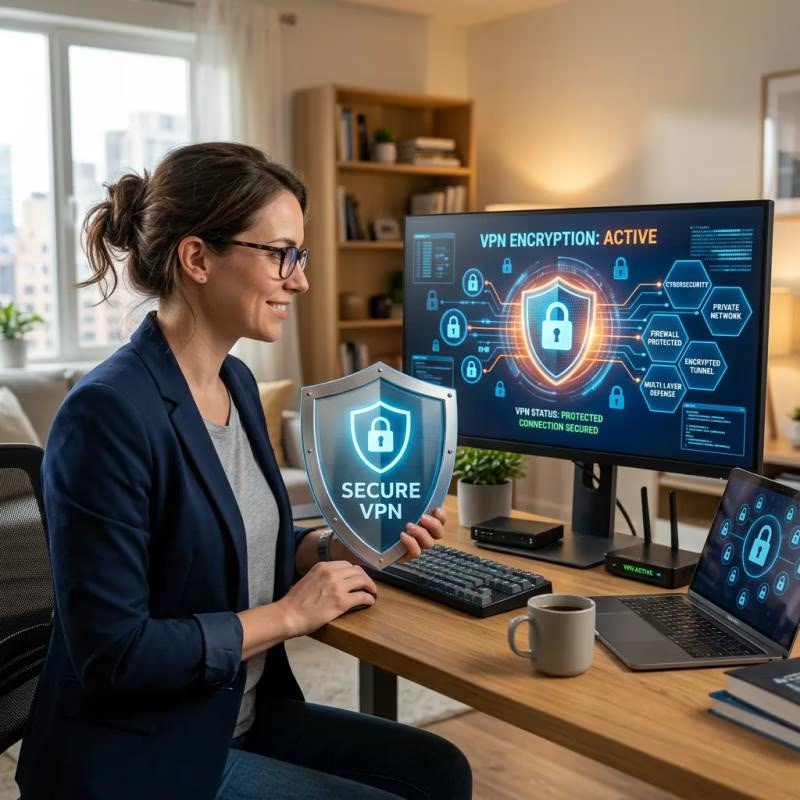
VPN Use: Your First Line of Defense
A VPN encrypts your internet traffic and masks your IP address. For webcam models, this is not optional — it is essential. Your IP address can reveal your approximate location to anyone who knows how to look. A VPN prevents that. It also prevents man-in-the-middle attacks on public WiFi, which is a real risk if you ever perform from a coffee shop, hotel, or co-working space.
Not all VPN providers are equal. Free VPNs log your activity and sell data — the opposite of what you want. Paid, reputable VPNs with a clear no-logging policy are worth the subscription cost. Look for providers based outside of Five Eyes surveillance alliance countries if you want maximum privacy. NordVPN, ExpressVPN, and Mullvad are commonly cited by privacy-conscious performers. Ultimately the choice is yours — just do not skip this step.
Protecting Your Location
Your location is the most dangerous piece of information you can accidentally expose. Performers have been doxxed — their real addresses published online — because of small mistakes: a visible street sign in a background, a license plate in a photo, a ringtone that plays a local radio station jingle.
Audit your physical space before every session. Use a neutral background that gives away nothing — a plain wall, a professionally designed backdrop, or a carefully curated shelf that reveals nothing identifiable. Search your background images on Google Images reverse search to check whether anything is identifiable. Check every angle: cameras are wide-angle by default, and things at the edge of frame can surprise you.
Geolocation metadata in photos is a specific risk. If you take promotional photos with your phone, disable location tagging in your camera app settings. Then strip existing metadata from any photos you have already taken using a tool like MAT2 or exiftool. This takes five minutes and can prevent years of headache.
Device Security and Password Hygiene
Your work computer or phone is a vault. Treat it accordingly. Use strong, unique passwords for every account — no reuse, no predictable patterns. A password manager is not optional at this point; it is mandatory. Bitwarden and 1Password both offer solid free tiers.
Enable two-factor authentication on every platform that supports it. SMS-based 2FA is better than nothing but is vulnerable to SIM-swap attacks. Use an authenticator app (Google Authenticator, Authy) wherever possible. If a platform allows hardware keys, use one.
Keep your operating system and software updated. Outdated software is the entry point for most malware. Enable automatic updates if you tend to forget. Run regular scans with a good antivirus program. These basics are not glamorous, but they stop the majority of attack vectors.
Scammers, Phishing, and Social Engineering
The adult industry attracts scammers disproportionately because payment processing is complex and because performers often work alone without institutional support. Common scams include:
- Fake tippers: Someone tips generously, then messages saying the tips were a mistake and asks you to send money back. Check your platform balance before responding to any such claim.
- Phishing emails: Emails pretending to be from your platform claiming your account is suspended and asking you to log in through a link. Always navigate directly to platform URLs rather than clicking email links.
- Social engineering: Long con artists who build trust over time and then ask for favors, access, or information. Maintain professional boundaries from the start.
The rule: if something feels off, pause. Legitimate platforms, clients, and collaborators will not pressure you to act urgently or bypass normal procedures.
Content Piracy and Watermarking
Your content will be stolen. This is not pessimism — it is certainty. People record cam shows and repost them to pirate sites within hours. While you cannot prevent all of this, you can track it and issue DMCA takedowns when it happens.
Use a unique watermark visible on your content — your performer name burned into the video — so that when it appears elsewhere, you can prove it is yours and file takedowns more effectively. Tools like BatchWatermark or online services can handle this in bulk. Register your content with the US Copyright Office if you are US-based — the registration fee is small and the legal standing it provides is significantly stronger.
Mental Health and Boundaries
Safety is not only digital. Performing online takes a psychological toll that is real and underdiscussed. The combination of constant visibility, income pressure, and sometimes aggressive or entitled viewers can erode your sense of self if you are not intentional about boundaries.
Establish clear rules for your room and enforce them consistently. Block immediately and without hesitation anyone who crosses your stated boundaries. Do not negotiate with people who push back on your limits — that is exactly the dynamic bad actors exploit.
Take breaks. Burnout is real. Many platforms allow you to set scheduled time off. Use it. Build a life outside of performing. The best long-term performers are the ones who treat it as a job, not an identity — and that requires having a self that exists beyond the camera.
Know Your Legal Exposure
Laws around cam modeling vary by country and are evolving rapidly. In some jurisdictions, income from adult performance is taxable; in others, it may trigger additional reporting requirements. Consult a tax professional who understands online business income. Look for accountants who specialize in creative or gig economy professions — they exist and they understand your situation.
In the United States and many European countries, performing as an adult is legal. What is illegal is certain types of content, certain forms of coercion, and operating without meeting specific regulatory requirements that vary by platform and jurisdiction. Know what applies to you. Ignorance is not a defense.
Building Sustainable Safety Practices
None of this is a one-time setup. Safety is an ongoing practice. Review your privacy settings on every platform you use quarterly, as platforms update their policies and interfaces frequently. Audit your digital footprint annually — search your performer name and see what comes up. Update your passwords every six months. Check that your VPN is still active and your security software is up to date.
The goal is not a perfectly secure setup — that does not exist. The goal is a security posture that makes targeting you substantially more difficult than targeting someone who has not thought about these things. Most bad actors look for easy targets. Make yourself a hard one.
The Platform Relationship
Most performers work through established platforms rather than independently. The platform handles payment processing, provides the audience, and manages the technical infrastructure. In exchange, the platform takes a cut — typically 30% to 50% of what you earn. This is a significant chunk, but it comes with real benefits: built-in traffic, verified payment systems, and some degree of institutional protection against fraud and chargebacks.
However, that institutional protection has limits. Read the terms of service for every platform you join. Understand what happens to your content if the platform shuts down, gets acquired, or changes its policies. Know whether the platform claims ownership of your recorded content or merely licenses it. These distinctions matter, especially as your archive of recorded shows grows over time.
Physical Security Beyond the Camera
Performing from home means your home address is theoretically accessible to anyone who is determined enough to find it. Beyond the digital precautions, consider physical security. Use a PO box or dedicated business address for any mail related to your cam work. If you receive packages, use aLocker or similar service rather than having materials delivered to your door. Some performers use fake names on doorbells and apartment buzzers to prevent identification by delivery personnel.
These steps may seem paranoid, but they are standard practice among performers who have been in the industry long enough to see the consequences of cutting corners. Privacy is a system. Each layer adds protection. Skipping layers because they seem excessive is how leaks happen.